
Why a Low Headline Rate Can Still Mean a High Bill
By That Card Machine Guy

Why can a low headline card rate still mean a high bill?
A low headline card rate is only one part of your total card processing cost. Your monthly bill may also include a fixed fee for every transaction, terminal rental, statement charges, PCI fees, gateway charges and other monthly costs.
These extra charges matter most when your customers make lots of small purchases. A 12p transaction charge may look minor, but 800 transactions add £96 to your bill. Once all costs are included, your effective card processing rate can be much higher than the rate shown in an advertisement or quote.
That is why comparing business card processing rates based on the percentage alone can give a misleading result. The more useful figure is the total amount you pay as a percentage of your card takings.
What is the difference between a headline rate and an effective card rate?
A headline rate is usually the percentage charged on the value of each card transaction. For example, a provider may advertise a rate of 0.9%.
That percentage charge is calculated from your card turnover:
- £10,000 in card takings at 0.9% = £90
However, the percentage charge may not include:
- A pence charge for each transaction
- Card machine or terminal rental
- Statement or account fees
- PCI compliance charges
- Gateway or authorisation charges
- Minimum monthly service fees
- Different rates for debit, credit and commercial cards
Your effective card processing rate includes the total cost of accepting card payments:
Total card processing costs ÷ card takings × 100 = effective card rate
For example:
£150 in total monthly card costs ÷ £10,000 in card takings × 100 = 1.5%
The effective rate gives you a clearer view of what card payments really cost your business.

Worked example: how 0.9% can cost more than 1.4%
Consider a small UK business with:
- £10,000 in monthly card takings
- 800 card transactions
- An average basket of £12.50
- A headline rate of 0.9%
- A transaction charge of 12p
- £30 monthly terminal rental
- £3 monthly statement fee
The monthly charges would be:
- Percentage fee: 0.9% × £10,000 = £90
- Transaction charges: 800 × £0.12 = £96
- Terminal rental: £30
- Statement fee: £3
Total monthly card processing cost:
£90 + £96 + £30 + £3 = £219
Now calculate the effective rate:
£219 ÷ £10,000 × 100 = 2.19%
Although the headline rate is only 0.9%, the business is paying an estimated 2.19% overall.
Now compare that with a flat rate of 1.4% and no additional charges:
- 1.4% × £10,000 = £140 per month
In this example, the apparently higher 1.4% flat rate costs £140 per month, compared with £219 per month under the lower headline rate.
That is a difference of:
£219 − £140 = £79 per month
Or £948 over a year, assuming the same turnover and transaction pattern.
The main reason is the average basket size. With 800 transactions, the 12p charge adds nearly another 1% of the business's £10,000 turnover:
£96 ÷ £10,000 × 100 = 0.96%
For a business taking many small payments, per-transaction charges can quickly outweigh a small difference in the percentage rate.
Why small average basket sizes make fees bite
A percentage fee changes with the value of the sale. A 0.9% charge on a £100 purchase is 90p, while the same rate on a £5 purchase is only 4.5p.
A fixed transaction charge works differently. A 12p fee is still 12p whether the customer spends £5 or £100.
On a £5 transaction:
- 12p equals 2.4% of the sale
On a £50 transaction:
- 12p equals 0.24% of the sale
This is why small businesses such as cafés, takeaways, market traders, salons and convenience shops need to look closely at both:
- Their average transaction value
- The number of card transactions they process each month
Two businesses can have the same monthly card turnover but very different costs. The business processing 800 payments may pay much more than one processing 200 payments if both have the same per-transaction charge.
Which card processing fees should you include?
To calculate your true merchant service charges in the UK, include every cost connected with accepting card payments for the period you are reviewing.
Percentage charges
These are the charges based on the value of your card sales. Your statement may separate them into different categories, such as:
- Debit card processing
- Personal credit card processing
- Commercial or business card processing
- Premium or international card processing
- Online or manually entered transactions
Do not assume that one quoted debit rate applies to every card payment. Your actual card mix may include credit and commercial cards charged at different rates.
Per-transaction charges
Look for charges described as:
- Transaction fees
- Authorisation fees
- Processing fees
- Switching fees
- Acquirer transaction charges
These may appear as a number of transactions multiplied by a pence charge. Even a small amount can become significant when transaction volumes are high.
Terminal rental and small business card reader fees
Your card machine or card reader may be charged separately from your transaction fees. Look for lines such as:
- Terminal rental
- Card machine rental
- Equipment rental
- Monthly device fee
- Maintenance or support charge
Include these costs if you want to understand the total cost of accepting cards. A terminal fee may be charged even during a quiet month when your card takings are low.
PCI fees
PCI-related charges cover payment card security and compliance services. Your statement may call these:
- PCI compliance fee
- PCI programme fee
- Data security fee
- Non-compliance fee
Check whether the fee is charged monthly, annually or only when required action has not been completed.
Gateway, account and minimum monthly fees
Other charges may include:
- Payment gateway fees
- Merchant account fees
- Monthly service fees
- Statement fees
- Minimum monthly service charges
- Connectivity fees
- Authorisation charges
A minimum monthly fee can be particularly important for seasonal businesses. You may pay it even when your percentage-based charges are low.
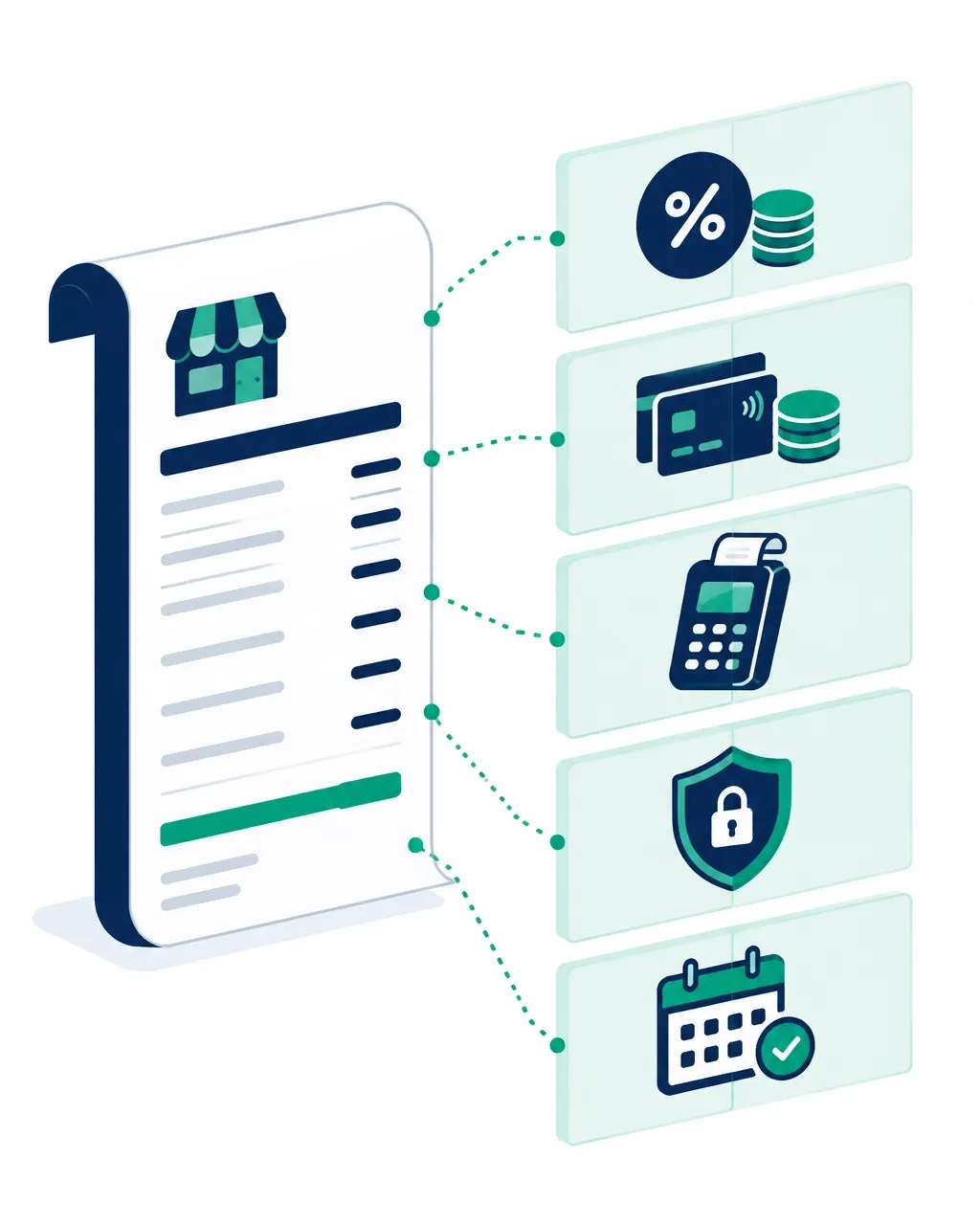
Where can you find these costs on a merchant statement?
Start with the statement summary. It may show your total card turnover, the total amount deducted and the amount paid into your bank account.
Then review the detailed fee section. Depending on the provider, charges may be grouped under headings such as:
- Merchant service charge
- Processing fees
- Transaction charges
- Other fees
- Monthly charges
- Equipment charges
- Compliance fees
- Adjustments
If you cannot identify a charge, check the fee schedule or contract that came with your merchant account. The statement may use abbreviations, while the fee schedule explains what each abbreviation means.
Use the same period for both sides of the calculation. For example, compare one month's card takings with the fees charged for that same month. If you are reviewing a quarterly statement, use the card turnover for those three months and include the full quarter's fixed charges.
Common mistakes when comparing business card processing rates
Looking only at the advertised percentage
A 0.9% rate may not be cheaper than a 1.4% rate once transaction and fixed fees are included. Always calculate the total cost in pounds and pence.
Ignoring the number of transactions
Transaction charges depend on payment volume, not just turnover. Include your monthly transaction count when comparing offers.
Using the wrong card mix
If your customers use a mixture of debit, credit and commercial cards, a single debit rate will not represent your actual cost. Use the proportion of each card type by sales value where possible.
Comparing different periods
Do not compare one provider's monthly costs with another provider's quarterly figures. Use the same turnover, transaction count and billing period.
Adding fees twice
If you are working from a total bill, terminal rental and PCI charges may already be included. Do not add them again unless you are breaking the bill down from separate figures.
Forgetting VAT treatment
Check whether the figures you are comparing include VAT. Use the same VAT basis for your current costs and any alternative estimate.
Treating an estimate as a quote
Your calculated rate is an estimate based on the figures entered. Refunds, chargebacks, international cards, minimum charges, billing dates and pricing structures can affect the final amount on a statement.
Work out your own effective card rate
You can use the free, independent CardFeeCheck card processing fee calculator to estimate what accepting cards costs your business.
You can enter:
- Monthly card turnover
- Total fees from a merchant bill
- Debit, credit and commercial card mix
- Transaction charges
- Terminal rental
- PCI fees
- Statement and other monthly costs
You can also enter another provider's rates and compare the estimated monthly and annual cost using the same sales figures.
CardFeeCheck does not recommend a payment provider and does not require you to upload a statement. Calculations take place in your browser, and results are estimates based on the figures you enter.
Related guides to read next
Once you know your total monthly cost, these guides can help you investigate further:
- How to Calculate Your Effective Card Processing Rate — learn how to turn your total fees and card turnover into a meaningful percentage.
- What Does a 1% Card Fee Cost Per Month? — see how a percentage charge translates into pounds and pence at different turnover levels.
- Card Machine Rental vs Transaction Fees — understand how fixed card reader costs compare with charges based on each payment.
- How to Read a Merchant Statement — for a closer look at the charges on your own statement.
- Back to all Card Fee Guides
The person behind the calculator
About the author
Written by That Card Machine Guy. I run CardFeeCheck and also help UK businesses with card machines and processing costs. The calculator is free, independent and provider-neutral.