
How to Calculate Your Effective Card Processing Rate
By That Card Machine Guy

How do I calculate my effective card processing rate?
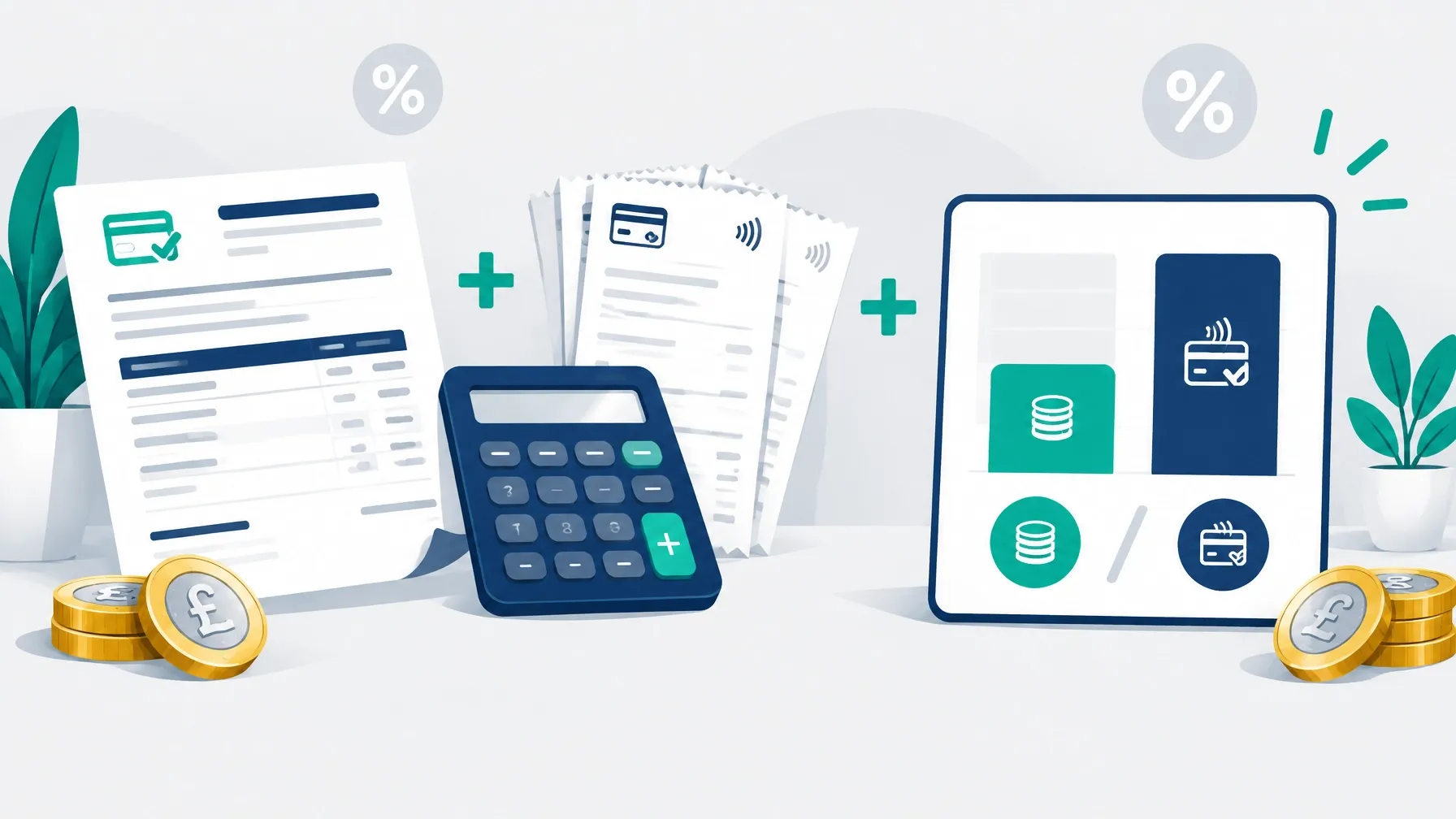
Your effective card processing rate is the total cost of accepting card payments divided by your total card takings for the same period, multiplied by 100.
The formula is:
Effective card processing rate = total card processing costs ÷ total card takings × 100
Use a full month where possible. Include the fees connected with accepting cards, not just the percentage shown in your payment provider's headline rate.
Worked example
Imagine your business takes £10,000 in card payments during one month. Your card-related costs are:
| Cost | Monthly amount |
|---|---|
| Percentage-based processing fees | £90 |
| Transaction charges | £30 |
| Card machine rental | £20 |
| PCI or account fee | £10 |
| Total monthly card costs | £150 |
Your calculation is:
£150 in total monthly card costs ÷ £10,000 in card takings × 100 = 1.5%
Your effective card processing rate for that month is therefore 1.5%.
Why your effective rate matters
A provider may advertise a rate such as 0.6%, 1% or 1.5%. That figure may only cover one part of your card processing cost.
You could also pay:
- A fixed charge for every transaction
- Card machine or terminal rental
- Monthly account or software fees
- PCI compliance or security fees
- Gateway fees for online payments
- Minimum monthly charges
- Different rates for debit, credit, commercial or international cards
Your effective rate combines these costs into one figure. This makes it easier to understand what you actually paid to accept cards during the month.
It also gives you a more useful number when comparing another quote. A lower advertised rate is not necessarily cheaper once all the fixed and transaction costs are included.
Which fees should I include?
For a useful calculation, include costs that relate to accepting card payments during the period you are measuring.
Percentage-based processing fees
These are usually calculated as a percentage of your card sales. On a statement, they may appear as:
- Merchant service charge
- Processing fee
- Discount fee
- Card acceptance fee
- Interchange and processor charges
If your statement separates fees by card type, add the relevant debit, credit and commercial card charges together.
Per-transaction charges
Some providers charge a fixed amount every time a customer pays by card. For example, you might pay 10p, 15p or 20p per transaction, in addition to the percentage fee.
These charges matter more when your average transaction value is low. A 15p charge is a small amount on a £100 sale, but it represents 1.5% of a £10 sale.
Find the number of transactions and the total transaction charges on your statement. If they are not shown separately, check your pricing agreement or provider's fee schedule.
Card machine rental
If you rent a card machine, include the monthly rental cost. It may be listed as:
- Terminal rental
- PDQ rental
- Card reader rental
- Equipment charge
- Device hire
Include the charge even if the terminal processed no payments on a particular day. It is still part of the monthly cost of having the card payment service available.
PCI, account and other monthly fees
Look for recurring charges such as:
- PCI compliance fees
- Statement fees
- Account fees
- Gateway fees
- Software or platform charges
- Monthly minimum fees
- Service or support charges
A small monthly charge can make a noticeable difference if your business has modest card turnover.
For example, an extra £25 per month is only 0.25% of £10,000 in card sales. But it becomes 1.25% of £2,000 in card sales. The same fixed fee has a much larger effect when your card turnover is lower.
Where can I find the figures?
Start with your latest merchant statement or payment provider report. You may need to check more than one document.
Look for:
- Total card takings for the period
- Total number of card transactions
- Percentage-based fees
- Per-transaction charges
- Monthly or account fees
- Terminal rental or equipment charges
- PCI, gateway or software fees
You may also find relevant costs on:
- Your card machine rental invoice
- Your payment gateway invoice
- Your software subscription invoice
- Your merchant agreement
- Your provider's pricing schedule
Use the same period for both sides of the calculation. For example, do not compare card takings from January with fees from a statement covering 15 January to 14 February.
If your provider charges on a different statement cycle, use that complete cycle instead. The important point is that the card sales and card costs cover the same dates.

Common mistakes when calculating an effective card rate
Looking only at the headline percentage
A headline percentage is not always your total cost. Add transaction charges and fixed fees before calculating your effective rate.
Using total business revenue
Use card takings, not total revenue, unless every sale was paid by card. If you also accept cash, bank transfers or other payment methods, leave those amounts out.
For example, if your total sales were £15,000 but only £10,000 was paid by card, use £10,000 as the denominator.
Forgetting small recurring charges
PCI, statement, software and terminal fees are easy to overlook because they may appear on separate lines or invoices. Even small charges should be included if you are calculating your total cost.
Mixing different months
Card turnover changes from month to month. A busy month may produce a lower effective rate because fixed fees are spread across more sales. A quieter month may produce a higher rate.
For a clearer picture, calculate your rate across several months or compare the same period each year.
Including one-off costs without labelling them
A one-off setup fee, replacement terminal or unusual charge can make one month look more expensive than normal.
You can include it if you want to know the full cost for that month. If you are measuring your ongoing rate, record it separately so you can distinguish regular costs from one-off expenses.
Comparing different types of payments
In-person, online, keyed and card-on-file payments may have different costs. If your business uses more than one payment channel, make sure any comparison reflects your actual mix.
Card type can matter too. Debit, credit and commercial cards may not be charged at the same rate.

Can I calculate my effective rate without uploading a statement?
Yes. You can work it out from the figures on your statement, and you do not need to upload the statement itself.
The free CardFeeCheck effective rate calculator lets you enter your card turnover and total fees to estimate your effective rate. For a more detailed estimate, you can add information such as:
- Debit, credit and commercial card mix
- Percentage fees
- Per-transaction charges
- Terminal rental
- PCI fees
- Other monthly costs
You can also enter another provider's rates and compare the estimated monthly and annual cost using the same sales figures.
CardFeeCheck is independent. It does not recommend a payment provider, and the results are estimates based on the figures you enter. Calculations take place in your browser, so you can use the tool without uploading a merchant statement.
Calculate your own effective card processing rate
Related guides
Once you know your effective rate, these are useful next steps:
- What Does a 1% Card Fee Cost Per Month?, see how a percentage charge translates into pounds and pence at different turnover levels.
- Card Machine Rental vs Transaction Fees, understand how fixed rental costs compare with charges based on each payment.
- How to Read a Merchant Statement, learn what common processing fee categories mean and where they may appear.
- Why a Low Headline Rate Can Still Mean a High Bill, see why a lower advertised percentage may not mean a lower bill.
- Back to all Card Fee Guides
The person behind the calculator
About the author
Written by That Card Machine Guy. I run CardFeeCheck and also help UK businesses with card machines and processing costs. The calculator is free, independent and provider-neutral.